
How Much Does an Accountant Cost for a Small Business in the UK?
Accountant fees vary depending on your business type, services needed, and how organised your records are. Here is what to expect and how to get the most from your accountant.
Blog 10
What Affects Accountant Fees, What Is Usually Included, and How to Keep Costs Under Control
Running a small business means keeping a close eye on costs. Rent, software, wages, stock, tax, insurance, and day-to-day expenses all add up quickly. So when you are thinking about hiring an accountant, one of the first questions tends to be a simple one: how much does an accountant actually cost for a small business in the UK?
The honest answer is that it depends. Accountant fees vary depending on your business type, transaction volume, turnover, VAT status, payroll needs, and how much support you want throughout the year. Some small businesses only need help once a year with a Self Assessment tax return. Others need monthly bookkeeping, payroll, VAT returns, management accounts, Companies House filings, and regular tax advice throughout the year.
The right accountant should not just process numbers. They should help you stay compliant, avoid penalties, understand your tax position, and make better business decisions. At SRZ Accountancy, we work with UK small businesses, sole traders, contractors, landlords, and limited companies. Our approach is built around clear, fixed-fee pricing — so you know exactly what you are paying before any work begins. You can view our current options on our accounting packages page.

What SRZ Accountancy charges
If you want a real figure rather than a range, these are our current fixed-fee starting prices. Your exact fee depends on your transaction volume and the services you need, so follow each link to see what is included in that package.
| Package | Starting prices | Good fit for |
|---|---|---|
| Sole trader | Essential from £49/month Growth from £69/month Business Plus from £89/month |
Self-employed people who need bookkeeping and a Self Assessment return. Essential covers up to 20 transactions a month. |
| Limited company | Essential from £69/month Growth from £95/month Business Plus from £125/month |
Companies needing year-end accounts, a Corporation Tax return, payroll and VAT returns. Essential covers up to 40 transactions a month. |
| Contractor | From £85/month | Contractors working through their own limited company. Covers up to 30 transactions a month. |
| Self Assessment | Essential from £99/return Growth from £129/return |
Individuals who only need their Self Assessment tax return prepared and filed. |
| CIS | Subcontractors & sole traders from £39/month Construction contractors from £79/month |
Contractors filing monthly CIS returns, and subcontractors claiming CIS tax back. |
| Landlords | Individual (one property) from £49/month Limited company (two properties) from £99/month |
Buy-to-let landlords and property companies that need property accounts and tax returns. |
Starting prices from our Packages page, September 2026. Book a free consultation for a fixed quote.
What affects small business accountant fees?
There is no single price that applies to every business. A sole trader with a small number of monthly transactions will usually need less support than a VAT-registered limited company with employees, subcontractors, and multiple software integrations.
The main factors that affect small business accountant fees include:
- Business structure — sole trader, partnership, contractor, landlord, or limited company
- Number of monthly transactions
- Whether bookkeeping is already organised and up to date
- VAT registration and the VAT scheme you use
- Payroll requirements and number of employees
- CIS returns for construction businesses
- Number of directors, employees, or subcontractors
- Whether you need regular advice or only annual filing
- Quality of your records and receipts
- Accounting software setup, such as Xero, QuickBooks, FreeAgent, or Nomi
If your records are tidy and your bank feeds are connected properly, the work is usually faster and more predictable. If receipts are missing, transactions are uncategorised, or old returns need correcting, the cost can increase — because the accountant has to spend more time cleaning up the records before anything useful can be done.
That is why good bookkeeping support often saves money in the long run. Clean records make accounts, VAT returns, tax planning, and HMRC submissions much easier for everyone involved.
Typical accountant services a small business may need
When comparing accountant costs, it is important to check what is actually included. A low monthly price can look attractive, but it may only cover limited annual filing. Other packages may include bookkeeping, tax advice, payroll, VAT, and ongoing support throughout the year.
Common small business accountancy services include annual accounts, Corporation Tax returns, Self Assessment tax returns, bookkeeping, VAT returns, payroll and payslips, CIS returns, confirmation statements, Companies House filings, dividend planning, tax efficiency advice, accounting software setup, HMRC correspondence, and deadline reminders.
For example, a sole trader may mainly need help with bookkeeping and a Self Assessment tax return. A limited company will typically need annual accounts, Corporation Tax, director payroll, dividends, bookkeeping, and often VAT returns as well. The combination of services you need shapes the fee more than any single factor.
If your business is VAT registered, professional VAT return support can reduce errors and help ensure returns are submitted on time. If you employ staff, outsourced payroll services can save significant admin time and reduce the risk of PAYE mistakes.
Fixed-fee accountant vs hourly accountant
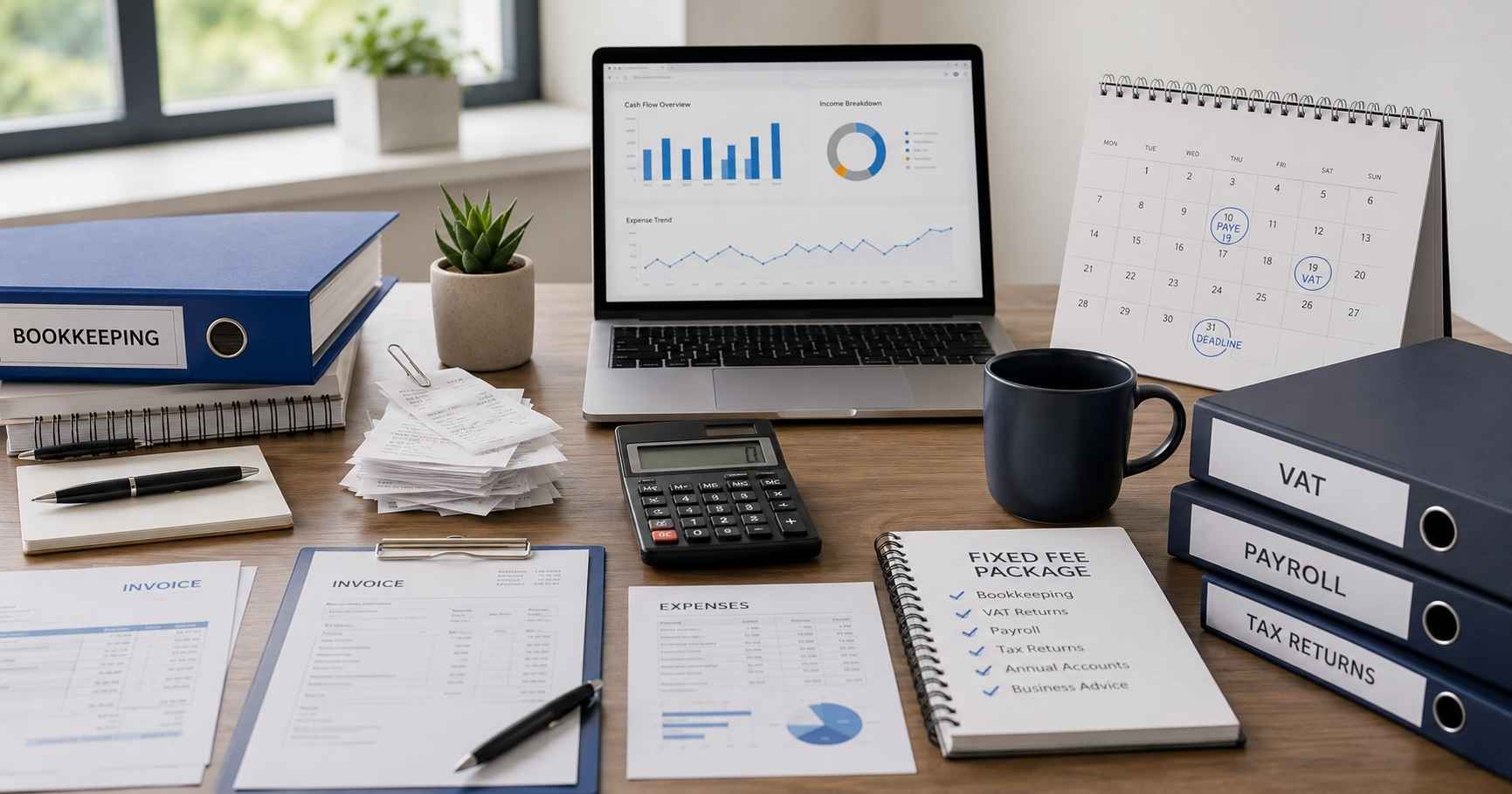
Small business owners often prefer fixed-fee accountancy because it makes budgeting easier and removes uncertainty. Instead of worrying about unexpected hourly charges, you agree the scope and monthly fee upfront.
A fixed-fee accountant usually works best when your needs are predictable — for example, monthly bookkeeping, quarterly VAT returns, payroll, annual accounts, and a tax return. This can be packaged into one regular monthly fee, which makes it easier to manage cash flow and plan ahead.
Hourly billing may still apply to one-off projects, complex tax investigations, or work that falls clearly outside the normal scope. But for most small businesses, fixed-fee accounting is simpler, more transparent, and easier to budget for.
Worth checking: When reviewing a fixed-fee package, confirm whether it includes bookkeeping, VAT returns, payroll, a Self Assessment for directors, the confirmation statement, and ongoing HMRC support — or whether these are charged separately.
A cheaper package is not always better value if it leaves important work outside the fee. The key is to choose a package that reflects how your business actually operates day to day.
Is an accountant worth the cost?
For many small businesses, an accountant is not just a compliance cost. A good accountant can prevent mistakes that become expensive to fix later, and help you make better decisions with clearer numbers.
Common areas where accountants add real value include: claiming allowable expenses correctly, avoiding late filing penalties, keeping VAT returns accurate, planning for tax bills before they arrive, choosing the right business structure, understanding cash flow, setting up bookkeeping software properly, making sure payroll is compliant, and keeping Companies House records up to date.
Missing deadlines can be costly. Self Assessment, VAT, PAYE, CIS, and Corporation Tax all have different filing and payment dates. Our dates and deadlines page gives a useful overview of the key UK compliance dates to keep track of throughout the year.
An accountant can also help you understand when to register for VAT, whether your business structure is still suitable as you grow, and how to plan ahead. If you are unsure whether you are paying too much tax, our guide on how to pay less tax in the UK explains several legal ways to improve tax efficiency.
Why cheap accounting can cost more later
It is natural to compare prices, especially when you are trying to keep business costs low. But accountancy is one area where the cheapest option can sometimes create more problems down the line.
Poor bookkeeping, missed VAT deadlines, incorrect payroll submissions, or late accounts can lead to penalties, interest charges, stress, and extra correction work — all of which cost more to resolve than they would have cost to prevent. If an accountant only prepares your accounts once a year, they may not spot issues early enough to fix them before deadlines arrive.
A better approach is to look at value rather than price alone. The right questions to ask are: will my accountant keep me updated throughout the year? Are fees clear before the work starts? Is bookkeeping included? Will they explain tax in plain English? Can they help with VAT, payroll, and Self Assessment? Will they remind me before deadlines? Can I contact them when I have questions?
The right accountant should make your business easier to manage — not just file forms after the year has ended.
How to reduce your accountant costs
You can often keep accountancy fees lower by staying organised. The less time your accountant spends chasing missing records, correcting old transactions, or sorting unclear payments, the more efficient — and more affordable — the service becomes.
Useful habits include: using cloud accounting software, connecting your business bank feed, keeping business and personal spending separate, uploading receipts regularly, categorising income and expenses consistently, responding quickly to accountant queries, keeping payroll and staff information updated, tracking VAT invoices properly, and avoiding leaving records until just before the deadline.
If you are not confident managing this yourself, outsourced bookkeeping can be a practical solution. It keeps your records current and gives your accountant better information throughout the year — which often makes the overall process faster and more cost-effective.
When should a small business hire an accountant?
You may benefit from hiring an accountant if you are starting a new business, becoming a limited company, seeing your income increase, registering for VAT, taking on employees, falling behind with bookkeeping, unsure about what expenses you can claim, receiving HMRC correspondence, or simply wanting clearer monthly numbers without the admin burden.
Many business owners wait until they are overwhelmed or close to a deadline before getting help. It is usually better to get support earlier. This gives your accountant time to organise your records properly, plan ahead, and help prevent avoidable problems before they become urgent.
Final thoughts
How much does an accountant cost for a small business in the UK? It depends on the level of support you need. A simple sole trader may only need basic Self Assessment help, while a growing limited company may need bookkeeping, payroll, VAT, accounts, tax planning, and ongoing advice throughout the year.
The most important thing is clarity. You should know what is included, what is not included, when work will be completed, and how your accountant will support you during the year — not just at the end of it.
At SRZ Accountancy, we provide fixed-fee accounting support for UK small businesses, contractors, sole traders, landlords, and limited companies. View our fixed-fee accounting packages or contact SRZ Accountancy to book a free consultation.
Book your free consultation
The best way to find out how we can help is a quick conversation. Tell us about your situation — your goals, your challenges, your current accountancy needs. The first meeting is always free, with no obligation and no sales pressure.